 Simulation Software for Fluids and Solids
Simulation Bridge Dynamic Self-Weight Stress Analysis
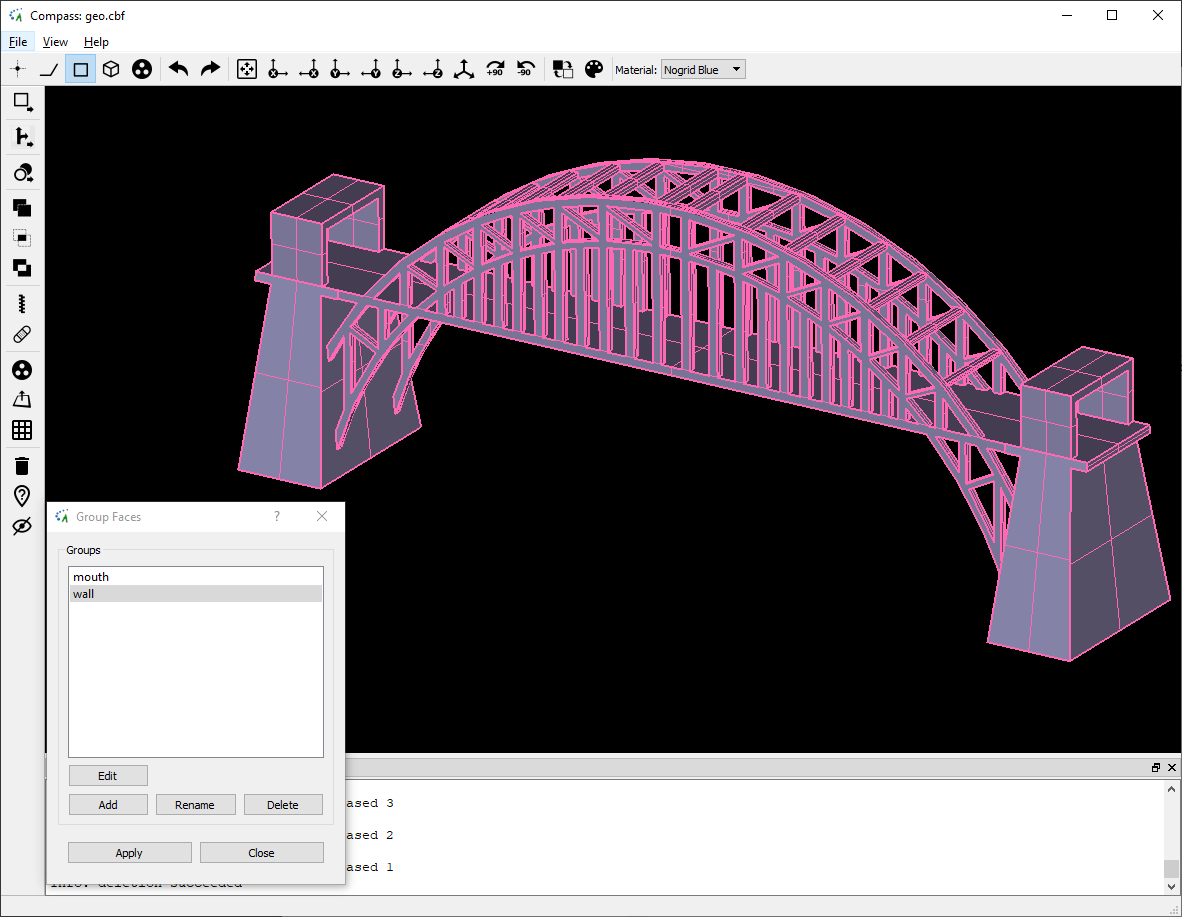
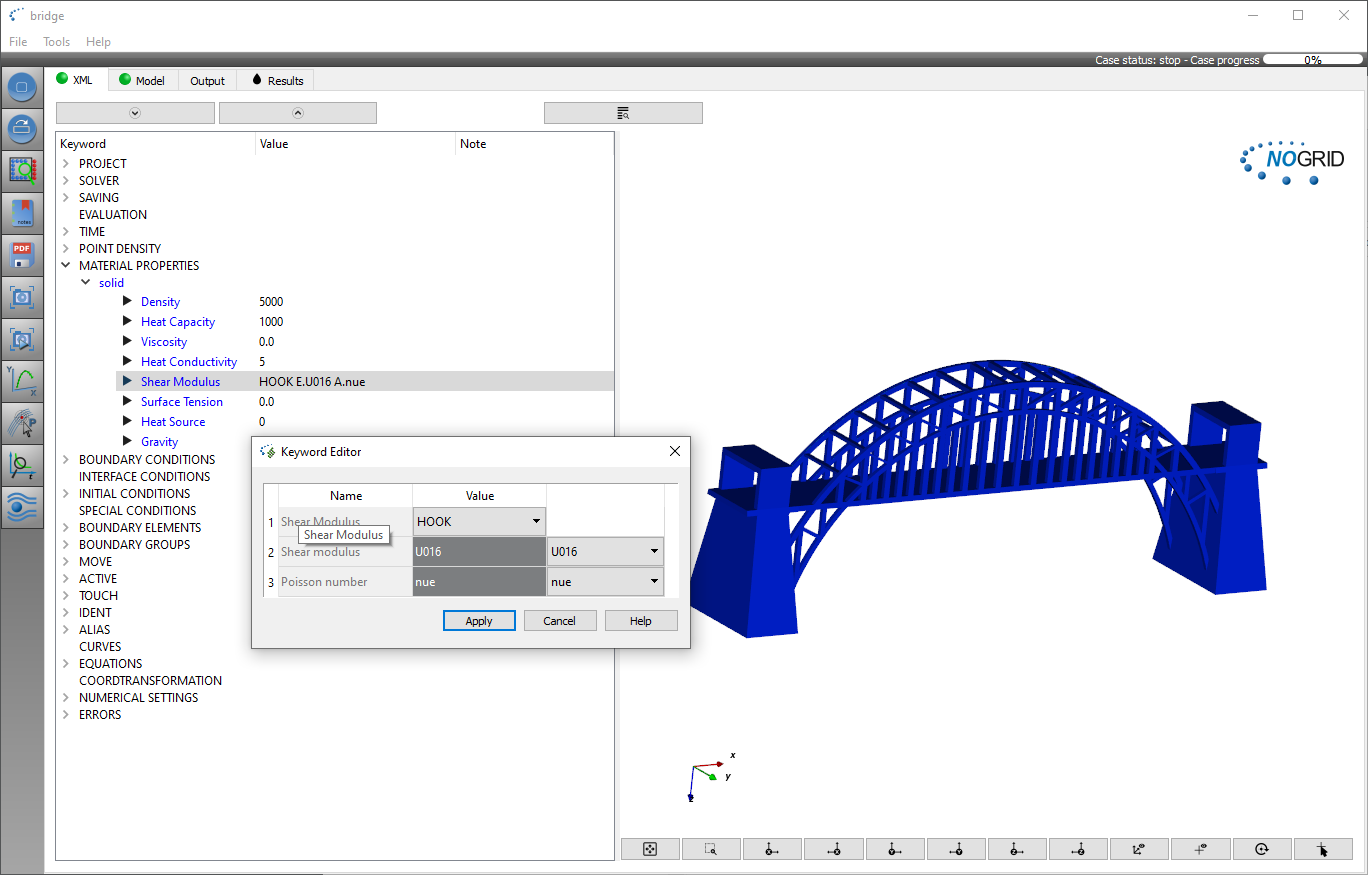
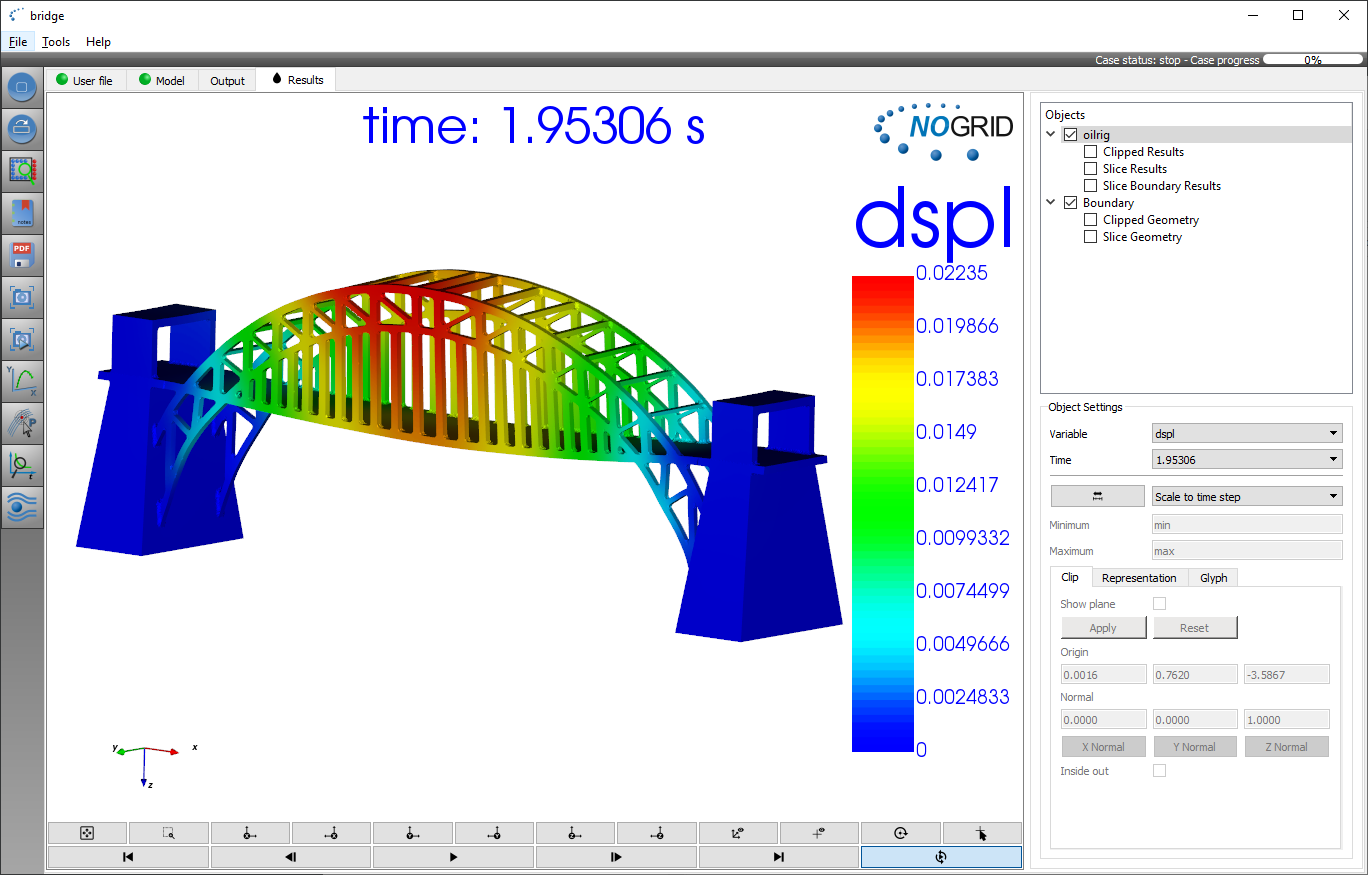
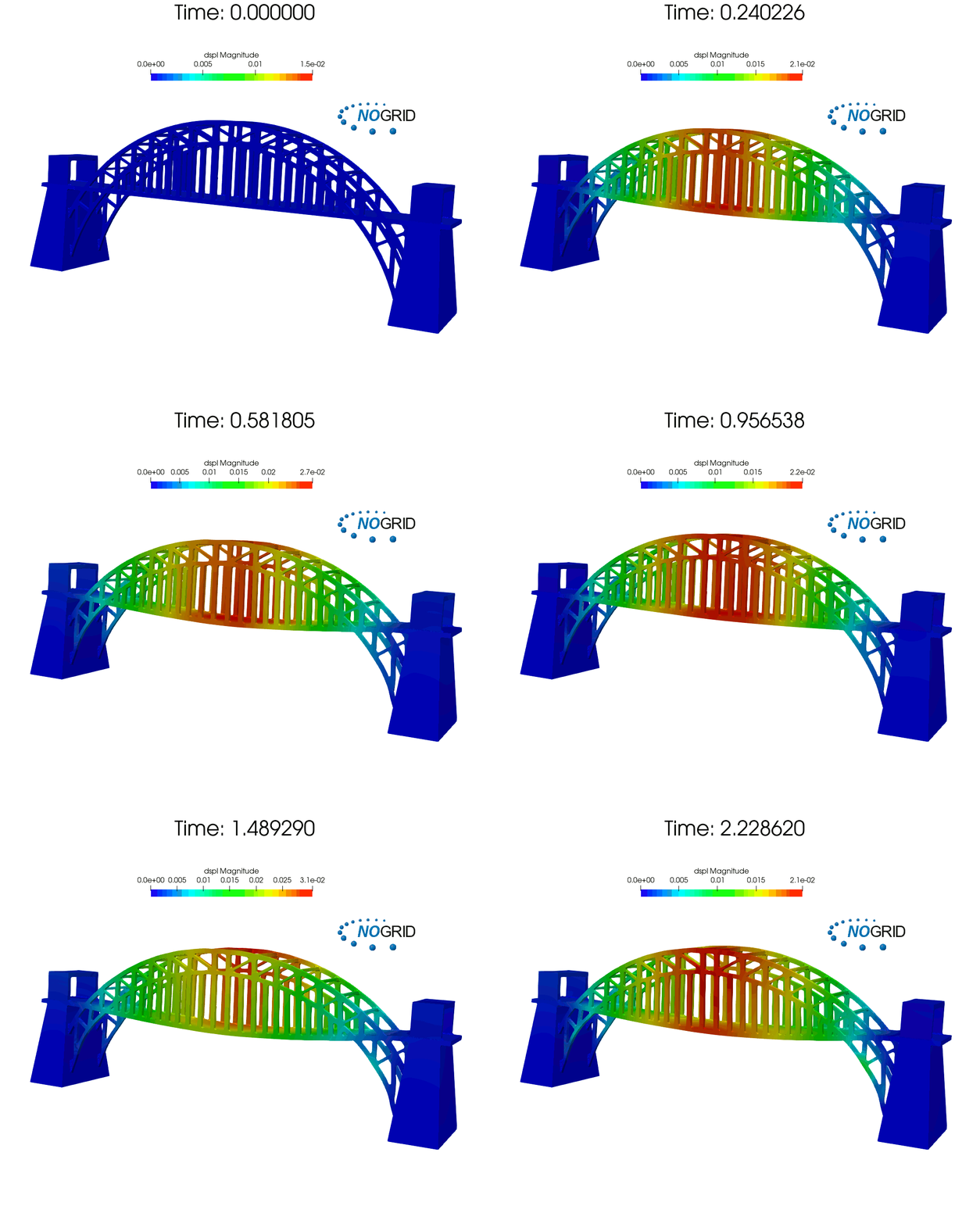
Here we present a simulation of a bridge considering a dynamic self-weight stress analysis. The bridge is modeled as a linear elastic material, which means Hooke's law is applicable. The computation starts with an initial geometry created using the CAD software. Due to its self-weight the bridge starts to deform. Due to these large deformations, motion and acceleration can no longer be neglected, as would be the case in the infinitesimal strain theory. Therefore, Newton's laws must be applied - the force acting on the body results in proportional acceleration, making a time-dependent analysis necessary.
Even though we used a linear elastic material in this case study, NOGRID software is also capable of computing viscoelastic materials as well. Unlike purely elastic bodies, viscoelastic materials exhibit both elastic and viscous behavior. The viscosity of a viscoelastic material gives the body a time-dependent strain rate. Purely elastic materials do not dissipate energy when a load is applied and then removed. In contrast, viscoelastic materials do dissipate energy under the same conditions.
Viscoelastic behavior has elastic and viscous components modeled as linear combinations of springs and dashpots, respectively. Each model differs in the arrangement of these elements. The elastic components can be modeled as springs of elastic constant E, given the formula:
σ = E ε
where σ is the stress, E is the elastic modulus of the material, and ε is the strain that occurs under the given stress, similar to Hooke's law. The viscous components can be modeled as dashpots such that the stress–strain rate relationship can be given as,
σ = η dε/dt
where σ is the stress, η is the viscosity of the material, and dε/dt is the time derivative of strain.
The implemented Maxwell model can be represented by a purely viscous damper and a purely elastic spring connected in series. According to this model, if the material is subjected to a constant strain, the stress gradually relaxes over time. When a material is subjected to a constant stress, the resulting strain has two components: First, an elastic component occurs instantaneously - corresponding to the spring - and relaxes immediately upon release of the stress. Second, a viscous component develops gradually and continues to increase as long as the stress is applied.
The implemented Kelvin–Voigt model consists of a Newtonian damper and a Hookean elastic spring connected in parallel. This model represents a solid undergoing reversible, viscoelastic strain. When a constant stress is applied, the material deforms at a decreasing rate, asymptotically approaching a steady-state strain. Once the stress is removed, the material gradually returns to its undeformed state. If the viscous stress is absent (η=0), the material behaves as a purely elastic body, and only Hooke's law applies.
In addition, the Generalized Maxwell model - also known as the Wiechert model - is implemented as well. It represents the most general form of the linear viscoelastic model. This model takes into account that the relaxation does not occur at a characteristic time, but over a distribution of times.
The Generalized Maxwell model consists of one or more Maxwell elements (each comprising a viscous damper and an elastic spring connected in series), optionally combined with a purely viscous element and/or a purely elastic element, all connected in parallel. A special deduction of the Generalized Maxwell model implemented in NOGRID software is the Tool-Narayanaswamy-Moynihan model.
NOGRID points can be used for designing and problem solving for all kinds of stress related tasks.
Capabilities of NOGRID points CFD software
NOGRID points combines the capability to handle stress computations for large deformations and various viscoelastic materials, allowing the simulation of any conceivable geometry and operating mode, such as
- fully 3D computation solving viscoelastic material behavior
- easy and intuitive setup
- freely definable material properties by user equations or user-defined curves
- Structure-structure interaction with viscoelastic materials
- Fluid-structure interaction using all implemented viscoelastic models
- computation of moving parts or moving boundaries in combination with viscoelastic materials
Why choose Nogrid?
NOGRID provides professional CFD software for the simulation of fluid flow, heat and mass transfer, and chemical reactions. Its efficient modelling workflow helps engineers analyse flow behaviour, evaluate designs and make informed decisions without creating a conventional volume mesh.
Faster model preparation
With NOGRID, only the geometry boundary needs to be meshed. The finite points inside the fluid domain are generated automatically according to user-defined settings, both at the start of the simulation and during the calculation.
This approach reduces preprocessing effort and makes it easier to prepare complex geometries and cavities for simulation.
Efficient CFD workflow
The modelling process follows four straightforward steps:
Build the geometry. Mesh the boundary. Define the simulation. Start the calculation.
NOGRID is designed to provide short computation times, including for applications involving complex cavities. Engineers can use the resulting data to examine flow distribution and other relevant flow characteristics.
Better insight into fluid-flow processes
CFD solves the fundamental equations governing fluid flow. NOGRID software enables engineers to predict and analyse the behaviour of fluids and related physical processes before or alongside physical testing.
The simulation results can support:
- evaluation and comparison of design alternatives
- optimisation of construction and operating parameters
- improved planning reliability
- reduction of development time and testing effort
- faster progression from design to market or operation
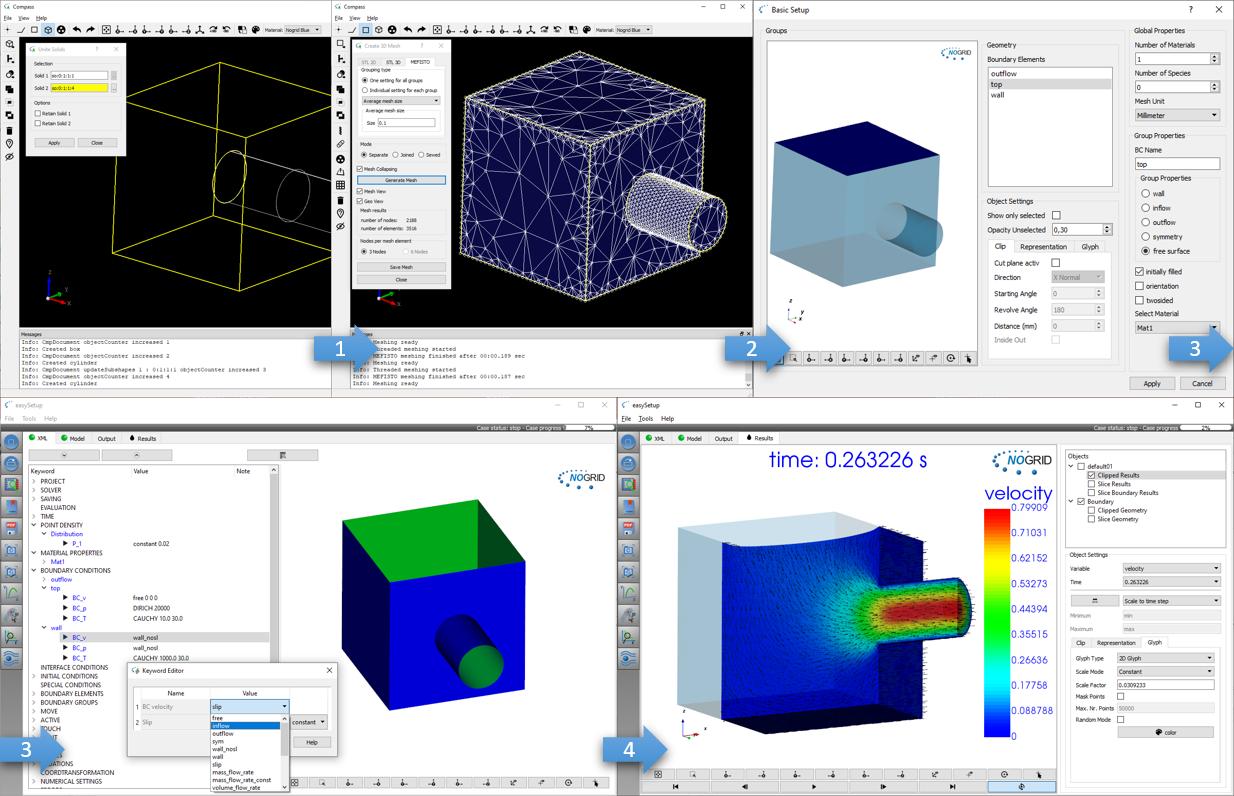
Steps from geometry generation to simulation results
TRAINING
Our two-day training courses teach participants how to set up, run and evaluate simulations efficiently with NOGRID CFD software. The courses include practical guidance for handling different types of simulation cases.
For more details please refer to Training Courses →
Technical Support
Professional support is available from the beginning of your work with NOGRID. Our technical team assists users by telephone and email with software operation, case setup and simulation-related questions.
For more details please refer to Software Support →
Simulation Service
When internal time, expertise or resources are limited, NOGRID can support your project with individual numerical simulation services. Our engineers develop and evaluate CFD models based on the specific requirements of your application.
For more details please refer to Software Support →