 Simulation Software for Fluids and Solids
Simulation Fluid-Structure Interaction 2D Sliding a filled Cup
The 2D simulation of a fluid-structure interaction (FSI) of a water-filled cup sliding can be performed with NOGRID points CFD software.
In this fluid-structure coupling, a boundary wall is switched off at a defined time. A cup filled with water is then accelerated by gravity and slides down an inclined plane. The cup is modeled as a rigid body that is free to move unconstrained when forces act on it. The single rigid body may collide with the bottom wall, which can alter its direction of motion. The collisions are assumed to be perfectly inelastic collisions in this study. An inelastic collision, unlike an elastic collision, is a collision in which the kinetic energy is not conserved due to the action of internal friction. The software is able to compute both collision regimes controlled by a plasticity coefficient.
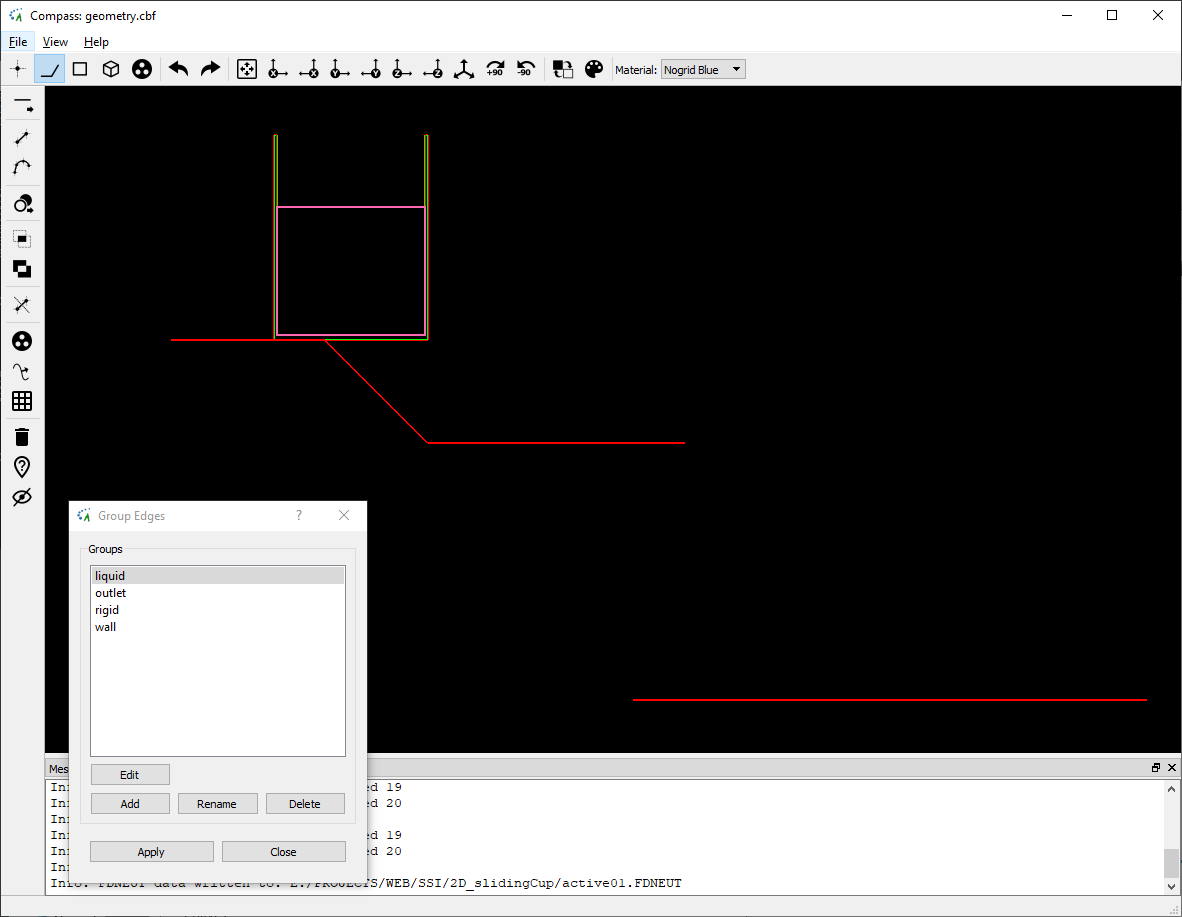
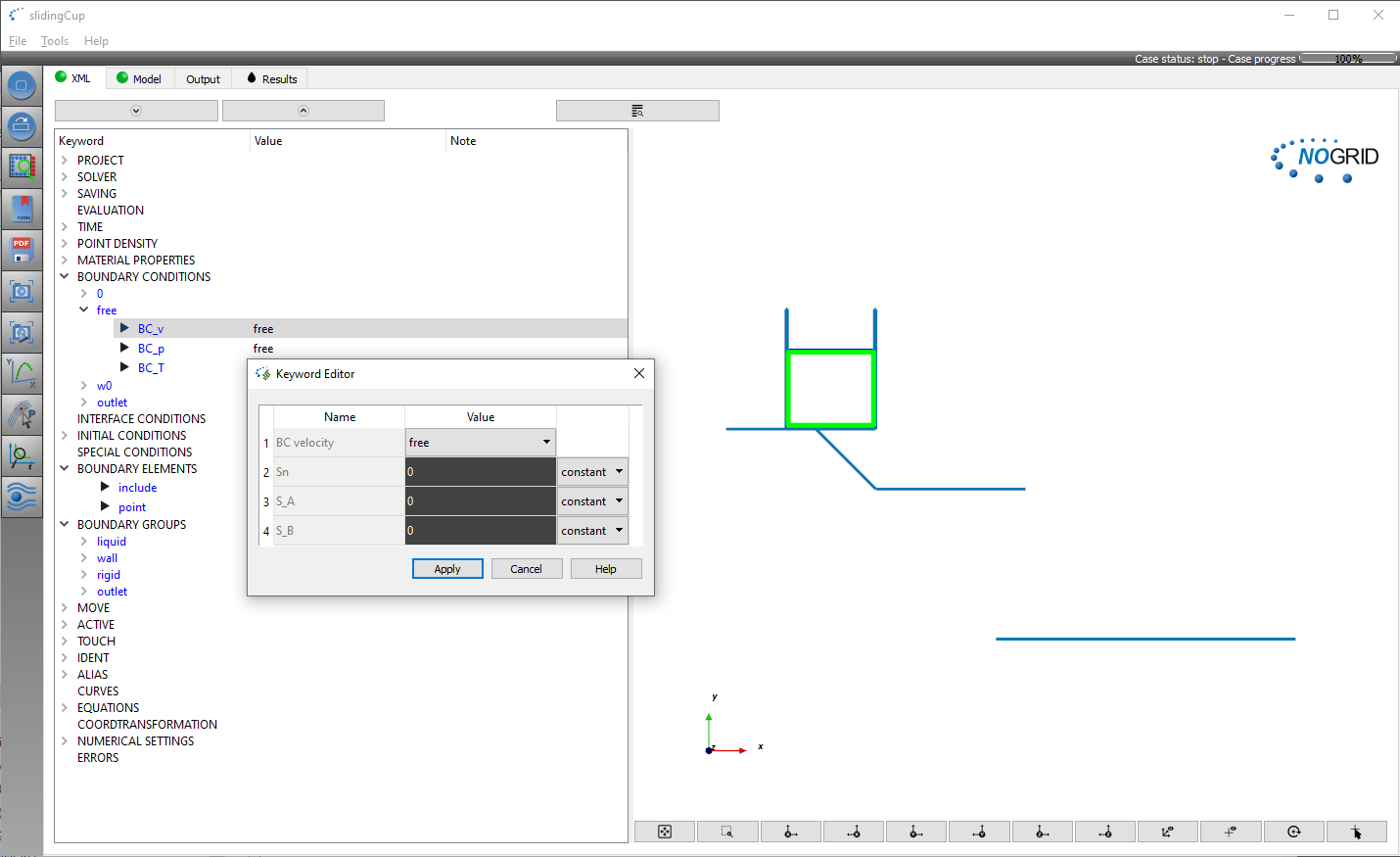
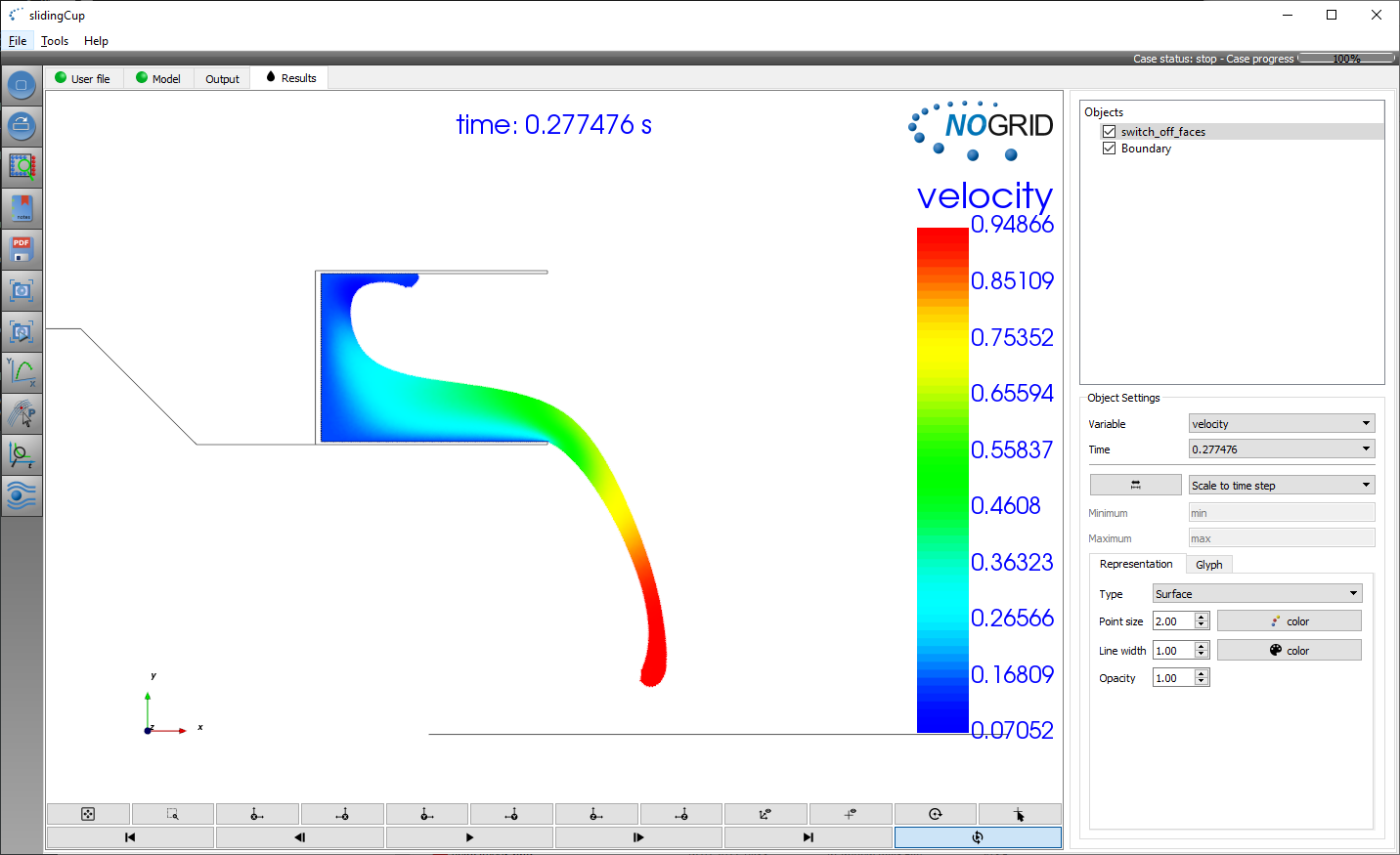
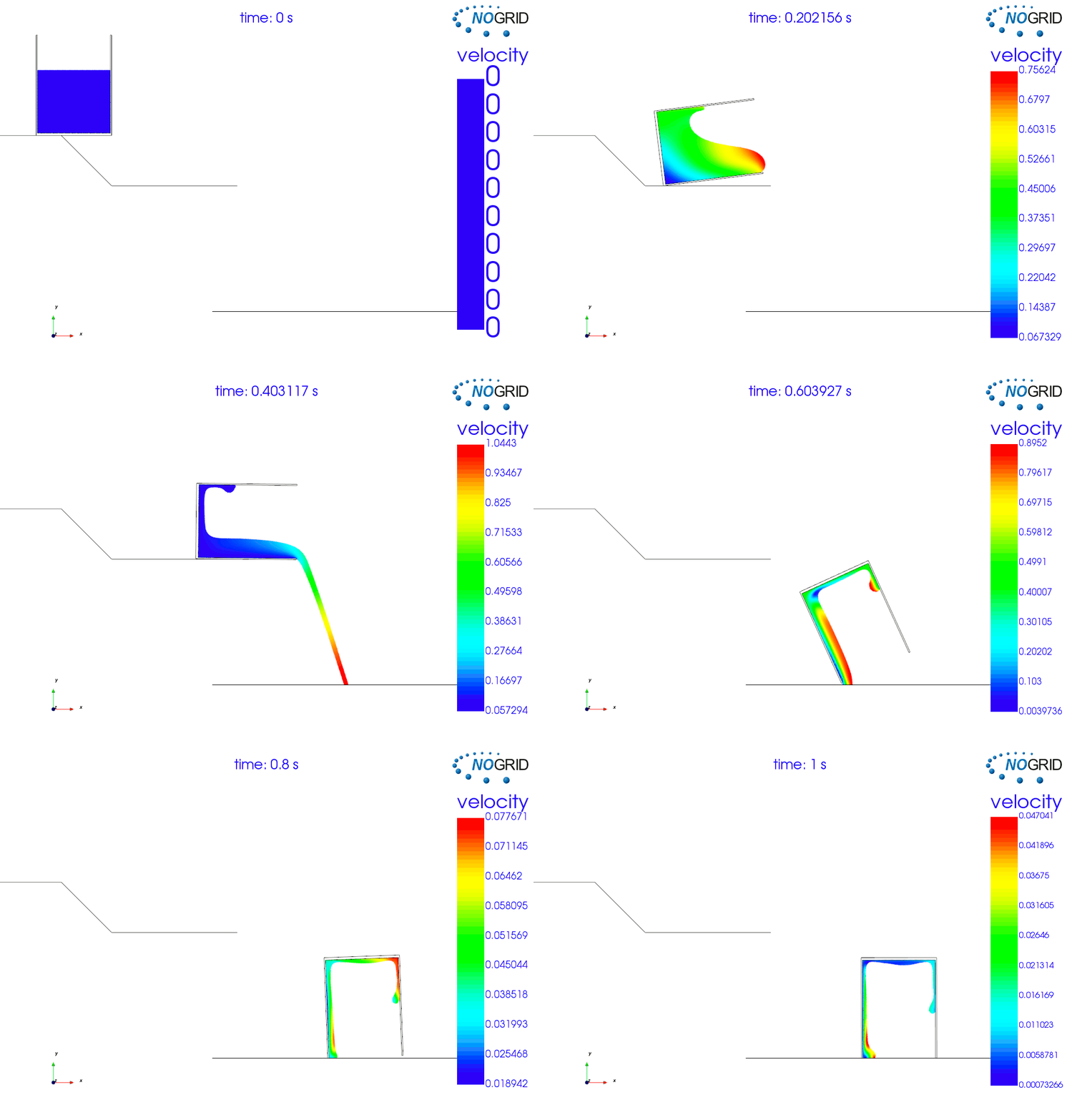
The fluid-rigid body interaction simulated in this study is solved in a fully coupled manner using a Lagrangian approach. Fully coupled means that the motion of the filled cup (translation and rotation of the rigid body) and the fluid variables for velocity and pressure are solved simultaneously in a large solution matrix (without the need for iterative switching back and forth between the solution variables necessary). In engineering, the term fluid-structure interaction (FSI) refers to the consideration of the mutual influence of moving, not necessarily rigid bodies, and a flow. Such interactions between fluid flow and bodies occur in many physical applications.
The fluid flow inside the cup causes both displacement and rotation of the rigid bodies due to the forces and torques exerted on the bodies by the fluid. Conversely, the motion of the cup causes changes in the flow. If the flow also changes due to the structure, there is a so-called real, two-sided fluid-rigid-body coupling. When several rigid bodies are involved, the motion of one body can additionaly also be affected by collisions with other bodies.
The cup in this simulation is assigned a weight and a mass moment of inertia, as is the case for any rigid body in FSI coupling. The rigid body responds according to the forces and torques exerted on it by the fluid. Conversely, of course, the flow is also influenced by the motion of the rigid body. The cup is assumed to slide smoothly on the ground in this case, meaning no resistance is introduced at the contact. In this study, friction between rigid bodies is neglected. The law of Coloumb friction (also referred to as dry or dynamic friction) is implemented for interactions between rigid bodies and walls, but it can be deactivated - as was done in this simulation.
NOGRID points can be effectively applied to the design and problem solving of all kinds of FSI processes. The software helps to understand the flow by computing and visualizing the mass, momentum, and motion of single as well as multiple rigid bodies. It provides transient data that can be used to analyze and evaluate the performance and efficiency of components or processes.
Capabilities of NOGRID points CFD software
NOGRID combines the capabilities to handle free surface flow and moving parts within the domain and allows the simulation of any conceivable geometry and operating mode, such as
- fully 3D computation solving the complete Navier-Stokes equations
- easy and intuitive setup also for FSI (Fluid-Structure-Interaction) cases
- freely definable material properties by equations or curves
- evaluation of chemical reactions and corresponding heat source terms
- open or closed domains including inflow and outflow areas (non-batch mode)
- moving of parts
Why choose Nogrid?
NOGRID provides professional CFD software for the simulation of fluid flow, heat and mass transfer, and chemical reactions. Its efficient modelling workflow helps engineers analyse flow behaviour, evaluate designs and make informed decisions without creating a conventional volume mesh.
Faster model preparation
With NOGRID, only the geometry boundary needs to be meshed. The finite points inside the fluid domain are generated automatically according to user-defined settings, both at the start of the simulation and during the calculation.
This approach reduces preprocessing effort and makes it easier to prepare complex geometries and cavities for simulation.
Efficient CFD workflow
The modelling process follows four straightforward steps:
Build the geometry. Mesh the boundary. Define the simulation. Start the calculation.
NOGRID is designed to provide short computation times, including for applications involving complex cavities. Engineers can use the resulting data to examine flow distribution and other relevant flow characteristics.
Better insight into fluid-flow processes
CFD solves the fundamental equations governing fluid flow. NOGRID software enables engineers to predict and analyse the behaviour of fluids and related physical processes before or alongside physical testing.
The simulation results can support:
- evaluation and comparison of design alternatives
- optimisation of construction and operating parameters
- improved planning reliability
- reduction of development time and testing effort
- faster progression from design to market or operation
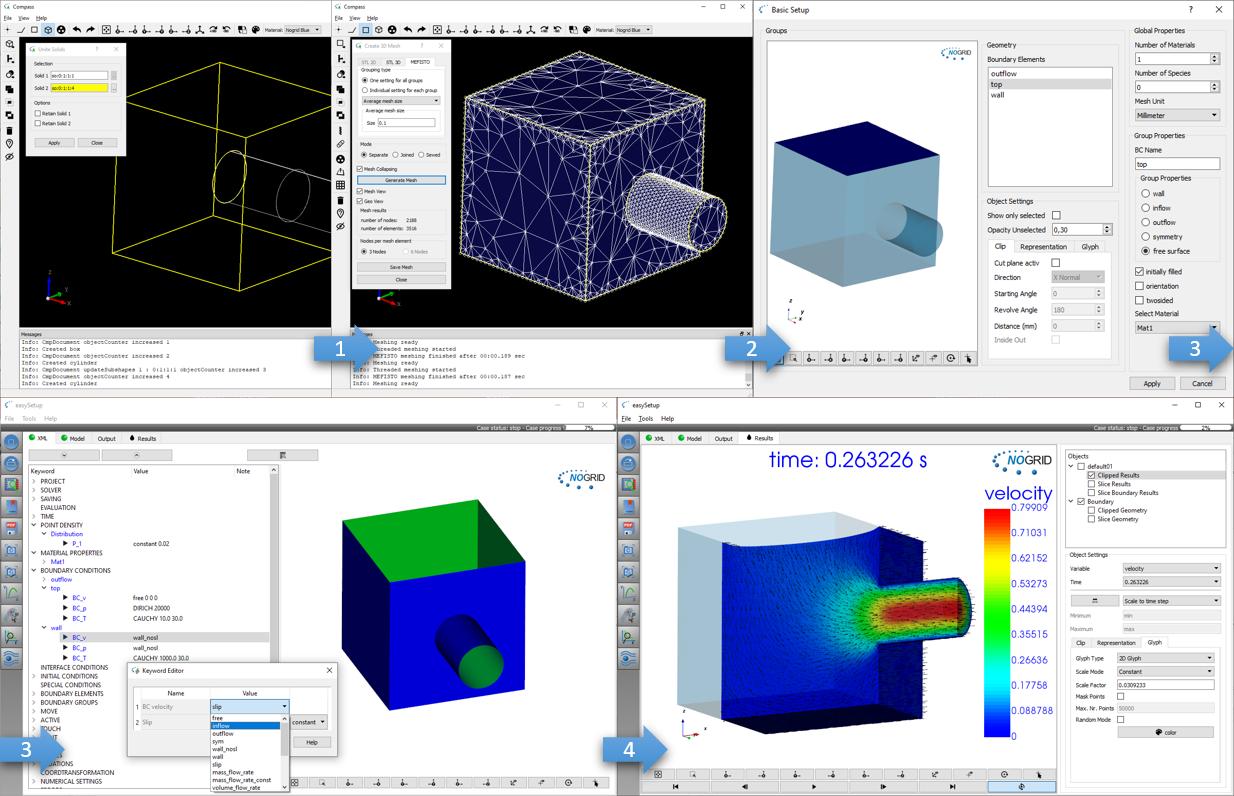
Steps from geometry generation to simulation results
TRAINING
Our two-day training courses teach participants how to set up, run and evaluate simulations efficiently with NOGRID CFD software. The courses include practical guidance for handling different types of simulation cases.
For more details please refer to Training Courses →
Technical Support
Professional support is available from the beginning of your work with NOGRID. Our technical team assists users by telephone and email with software operation, case setup and simulation-related questions.
For more details please refer to Software Support →
Simulation Service
When internal time, expertise or resources are limited, NOGRID can support your project with individual numerical simulation services. Our engineers develop and evaluate CFD models based on the specific requirements of your application.
For more details please refer to Software Support →